
Who me?
Who me?
Many of us read the following passage on Sunday, 7th June. It tells us about when Jesus called Matthew to join his group of disciples. Just as those who were fishermen immediately left their nets, so Matthew immediately left his tax booth and his whole way of life in order to follow Jesus.
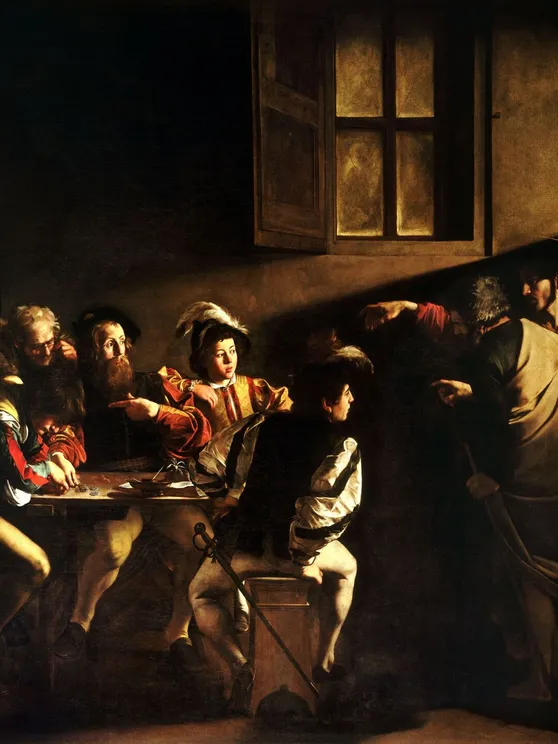
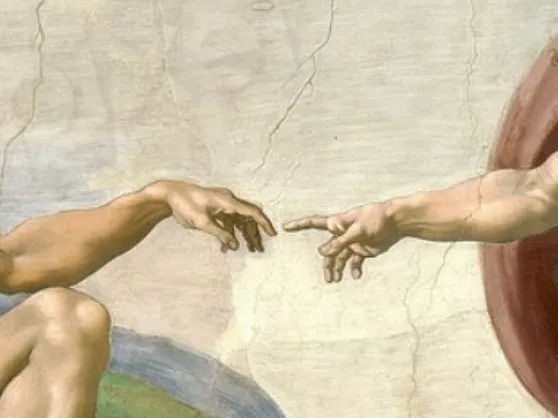
The image was painted about 1599 – 1600 by Caravaggio. It’s one of three commissioned for the Contarelli Chapel. We will use it to think about Jesus calling Matthew. The other is a section of Michelangelo's, The Creation of Adam (c. 1511). Click on the image to see an enlarged version. Click the cross in the top right to return to this text.
Bible Reading: Matthew 9:9-13
9 As Jesus was walking along, he saw a man called Matthew sitting at the tax booth; and he said to him, ‘Follow me.’ And he got up and followed him.
10 And as he sat at dinner in the house, many tax-collectors and sinners came and were sitting with him and his disciples. 11 When the Pharisees saw this, they said to his disciples, ‘Why does your teacher eat with tax-collectors and sinners?’ 12 But when he heard this, he said, ‘Those who are well have no need of a physician, but those who are sick. 13 Go and learn what this means, “I desire mercy, not sacrifice.” For I have come to call not the righteous but sinners.’
Matthew, like other tax collectors in first century Judea, worked for the Roman occupiers. Consequently, the Jewish authorities and people regarded them as a traitors – collaborators Tax collectors were therefore, regarded as perpetually religiously unclean, banned from the synagogue, considered to be compulsive liars and unable to give legal testimony in court.
The Romans would set people like Matthew a target tax to collect from his district. Anything collected above that was his to keep. This became a virtual licence to steal and extort; another reason tax collectors were despised. So, Jesus made an interesting choice in calling Matthew to join him in his ministry. However, God often used the outcast and flawed for his purposes, people like Rahab, Moses, and Judas. In verse 12 Jesus is saying that a Church that rejects sinners is just like a hospital that rejects the sick.
So why do you think Matthew is included in the twelve?
Caravaggio’s painting is an interpretation of Matthew 9:9, “Jesus saw a man called Matthew sitting at the tax booth, and he said to him, “Follow me.”
What we see is that God’s call arrived unexpectedly in the middle of a workday, Recall the calling of Samuel, Moses and Jonah.
Which character is Matthew? Religious art often uses types to give us clues. He’s often depicted with a long bushy grey beard. The two other paintings in the Contarelli Chapel, the Inspiration of St Matthew and the Martyrdom of St Matthew make it clear the man in the middle with the long beard is indeed Matthew, his right hand on the money, his left hand pointing.
But to whom is he pointing, at himself? Is this this a “who me?” response to Jesus’ call? Or is Matthew pointing to the young man on the left, also with his hand on the money, head down to avoid Jesus’ gaze? Some say that this is also Matthew. Mathew wrote his Gospel account around 60 or 70 AD, which suggests he was quite young when Jesus called him? What do you think? If Caravaggio has depicted both a young and an older Matthew what does that mean?
Notice that Jesus is pointing. Now look at the other picture, a section of Michelangelo’s, The Creation of Adam. Notice that Adam’s finger (on the left) is also pointing. Caravaggio has created Jesus’ hand and finger as a mirror image of Adam’s. In his letter to the Romans 5:12-21 Paul refers to Jesus as the second Adam. As the one sin condemned all people, in the same way the one righteous act – of Jesus sets all people free and gives them life. What is Caravaggio pointing to here?
There is a sword beside the near figure – for protection, for threats, or prestige? One figure wears a feather suggesting transient fashionable tendencies. Hands grab money – protecting it from the two outsiders who have burst in? All we see around the table suggests lives oriented toward gain, lives oriented towards self. The force of the painting lies in showing that precisely such a life can be addressed and transformed.
Jesus’ and the man with him (thought to be Peter) are wearing first century Middle Eastern dress, but the figures around the table are in European dress from Caravaggio’s time? Is Caravaggio trying to express that the Biblical events are as much for us in the present, and as real today, as they are historic?
The window over Christ’s head is grimy, cutting out the usual source of daylight (it also stops people from the outside seeing what’s going on). Illumination here comes with the caller – Jesus. Caravaggio is known for his use of light. Here the shaft of light is a metaphor as it enters the room with Jesus, the light of the world. The light reveals sin exposing the hands that grip money and the eyes that measure profit. However, there is no condemnation in Jesus’ expression, he is simply beckoning Matthew away, calling to a new life lived in the light not in the darkness of the tax collector’s booth.
Remember, if Matthew wrote Matthew’s Gospel then this passage is biographical. Matthew tells us he “rose up and followed Jesus” v9. Rose – is anastas in Greek: literally translated as "rising again" or "resurrection." Matthew not only follows Christ, for him it’s a resurrection moment. It’s the moment he turned from his old way of sin and was born again into a new life with Christ. (Matthew uses this Greek word when talking about the resurrection of the dead in chapter 22.)
So, what has the painting to say to us today? Caravaggio places us in the room; not behind, or with, Jesus and Peter; we have not arrived with them. We are in the room with the others, close enough to see the coins. Are we complicit with the group, seeking, expecting our share of the money? Are our lives lived in darkness, focused on the desires of the world?
How do we respond to the light that bursts in? How do we react to Christ’s call?
Does our love of wealth, or keeping what we have, or our desire for prestigious goods (the sword and feathered hat), or whatever the world regards as desirable prevent us rising from the table? Or is it fear about what our friends, our associates, might think if by leaving the room we imply disapproval at their way of life? Do we turn our backs on all that and follow Jesus out the door?
Caravaggio’s composition doesn’t ask what Matthew felt – it suggests Matthew’s response to Christ’s call is, “who me?” and asks us for our response when the light of the world unexpectedly enters our room.
Prayer
Lord Jesus, you call us to follow you. You call us to learn from you and be your disciples. You call us to take the Good News of the Gospel into all the world. May we rise from the table of darkness, greed, and selfishness to stand in your light and be counted among your faithful people. Fill us with your Holy Spirit that we may grow in our faith, share your love, and proclaim the Gospel of Salvation, that we may see your Kingdom grow in all sorts of wonderful ways. Amen.
Both images are from Wikimedia Commons, and faithful photographic reproductions of a two-dimensional, public domain work of art.